
Abandoned Cart Emails for a Clothing Store
A shopper picks a dress, a pair of jeans or a jacket, starts checkout, and leaves. In a clothing shop that is normal. People buy fashion with the eyes first, then the doubts arrive. A good abandoned cart flow answers the doubts.
This guide is for a small Shopify clothing shop using Klaviyo. It covers why clothing carts stall, what three emails should do, when to send them and what to check before you switch the flow on.
Why people leave a clothing cart
Think about what goes through the head of someone about to buy a coat from a shop they do not know yet.
- Size. Which size do I take? Does this brand run small?
- Fit. Will it sit right on me? The photo is on a model, not on me.
- Returns and exchanges. If it does not fit, can I send it back, and who pays for the postage?
- Shipping cost and time. The total at checkout is higher than the price on the page. Will it arrive before the trip or the event?
- Fabric and care. Does it need dry cleaning? Will it shrink?
- Trust. Is this a real shop? Will anyone answer if something goes wrong?
- Plain distraction. The phone rang. The bus came. Nothing is wrong with your shop.
Your emails cannot fix distraction, but a reminder does. They can help with most of the rest by answering the question before the shopper has to ask it.
An example shop
To keep this concrete, imagine a fictional shop called North Row Knitwear. It sells jumpers, scarves and a few shirts. Everything below is an example, not a real shop and not a real result.
The three emails
Email 1: the reminder
Job: bring the cart back while the shopper still remembers it.
- Show the actual cart: product names and quantities.
- One clear button back to checkout.
- Keep it short. No sales pitch yet.
- A few short promises, such as free exchanges, but only the ones that are true for your shop.
- Invite a reply: "Something stopped you? Tell us." A real person should read those replies.
In words, North Row's first email says: "Looks like you did not finish your order. No problem. We kept everything for you." Then the cart list, then the button.
Subject line ideas:
- Did something come up?
- Your cart is saved
- You left something in your cart
Email 2: answer the fit, returns and shipping doubts
Job: remove the reasons for hesitation.
Write a short list of the questions you really get:
- What if it does not fit? State your exchange or return terms exactly as they are: the window, who pays postage, how the new size is sent.
- How long does shipping take, and is there tracking?
- Size and fit help for the items in the cart, such as a size chart link or a note on how the item is cut.
- Where it is made and what it is made of. Only if you can back it up. Otherwise leave it out.
Rules for this email:
- Do not claim a fit, a fabric quality or an origin you cannot prove.
- Use a real customer review if you have one. If you have none, skip it. Never invent one.
- Repeat the cart and the button.
Subject line ideas:
- Questions about your order?
- Still thinking it over?
- Quick answers before you decide
Email 3: the last friendly nudge
Job: one polite final reminder, then stop.
- Say plainly that it is the last email about this cart.
- Optional: a small thank-you code. Only offer one if you can afford it and are happy to give it to everyone who reaches this email.
- No fake urgency. No countdown clock that resets. No "only 2 left" unless your stock really says so.
Subject line ideas:
- Last reminder about your cart
- One last note from us
- A small thank you, if you still want it
When to send them
These are suggestions, not figures from any study. Start here and adjust to your shop.
- Email 1: about 1 hour after checkout starts.
- Email 2: about 23 hours after email 1.
- Email 3: about 2 days after email 2.
A higher priced item, such as a winter coat or a suit, often means a longer decision. You may want wider gaps for those. Watch your own replies and orders and move the timings if they feel too pushy or too slow.
Also set the flow to stop as soon as the person places an order, so nobody gets a reminder for something they already bought. In Klaviyo this is a flow filter on the trigger: Placed Order zero times since starting this flow.
What to test
Change one thing at a time, and give each test enough orders to mean something. Ideas:
- A subject line that names the product versus a plain one.
- With a small thank-you code in email 3 versus without.
- Free exchanges stated in email 1 versus saved for email 2.
- A product photo versus a plain text cart list.
- A size chart link in email 2 versus none.
If your shop is small, keep it simple: run one version for a few weeks, note what happened, then change one thing.
Checklist before you go live
- Test checkout. Start a real checkout with your own email address and leave. Confirm the flow triggers.
- Check the cart link. Preview the email with a real Started Checkout event and confirm the cart list shows your products. Click the button once and confirm it lands on the right checkout. Klaviyo explains the checkout tags in its help pages: https://help.klaviyo.com/hc/en-us/articles/115005253088
- Check the discount link if you use a code. Make sure the code actually applies at checkout.
- Unsubscribe link. Every email needs a working one.
- Business address footer. Your business name and postal address belong in every marketing email.
- Policies match the copy. Shipping times, the exchange window and who pays postage in the emails must be what your shop page says.
- Stop on purchase. Confirm the flow excludes people who already ordered.
- Read it on a phone. Many people read email on a phone, so check that it looks right there.
A shortcut if you do not want to write them
If you would rather not write all this from scratch, the Starter Email Flow Kit for Klaviyo: Fashion Edition ($12) contains these 3 abandoned cart emails already written, with the cart list, the checkout button and the optional thank-you code in place. The example lines about exchanges and shipping times are samples: you edit them to match your shop, and lines marked "Shop fill-in" are blanks you complete with something true or delete. The kit makes no claims about fit, fabric or origin for you. It has 13 emails in 4 flows (welcome, abandoned cart, post-purchase and win-back), each as an HTML and a plain text file, plus a flow plan and an install guide. Klaviyo has no flow import, so you import the emails as templates and build each flow by hand.
Starter Email Flow Kit for Klaviyo: Fashion Edition
Not affiliated with Klaviyo or Shopify. Results depend on your products, your list and your edits.
The email designs and copy in the kit were made with AI help and curated by the seller.
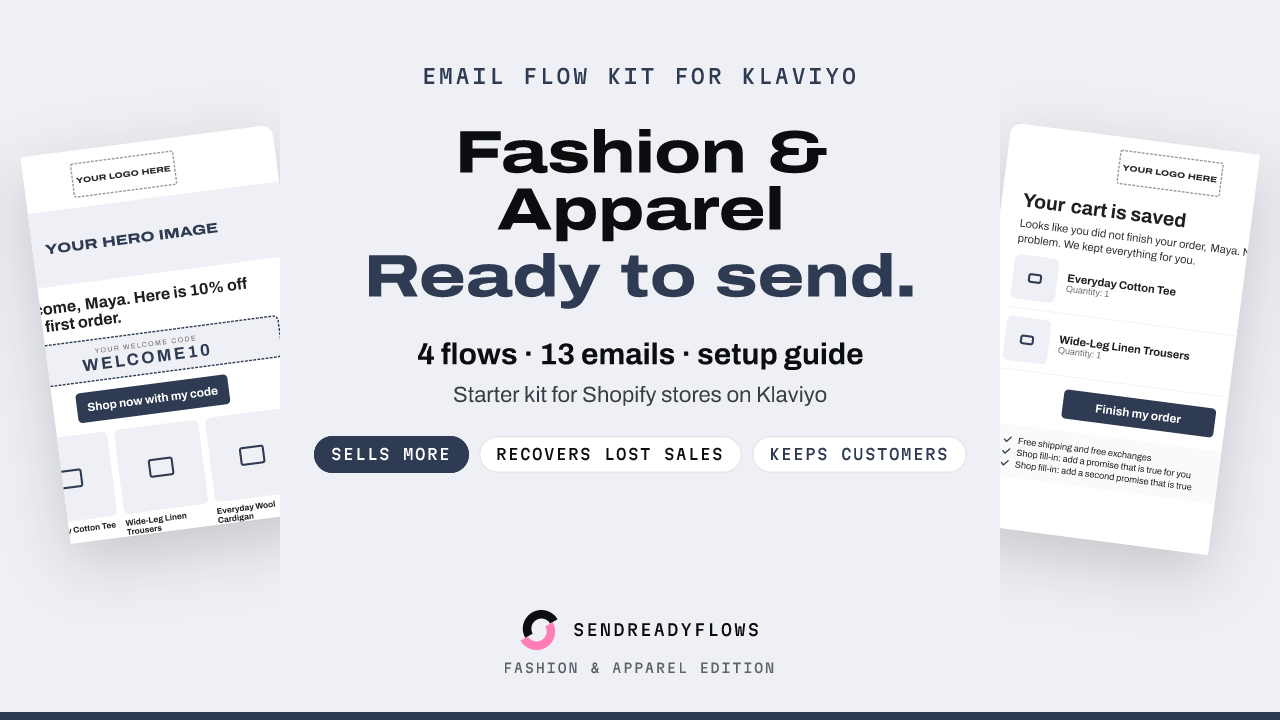
Starter Email Flow Kit for Klaviyo: Fashion Edition
$12 one-time, instant download
Get the kit
Starter Email Flow Kit for Klaviyo: Pet Supplies Edition
$12 one-time, instant download
Get the kit
Starter Email Flow Kit for Klaviyo: Beauty and Skincare Edition
$12 one-time, instant download
Get the kitWritten with AI help and checked before publishing. Not affiliated with Klaviyo or Shopify. A SHOK venture (shok.company). Owned and operated by Brinvik (brinvik.com), CVR 46724399